
Kepler-442 b
A real world. 7 imagined possibilities.
Watch this world orbit ↗Catalog central values; reported uncertainties, limits and sources are in the science record below.
Under these skies,
we imagined…
Explore this world through landscapes, life and stories. Each scene is connected to its intended planet and includes the science, the viewpoint and the details we invented.
Imagined alien life02 imagined views
Kepler-442 bKepler-442 b — dayImagined alien life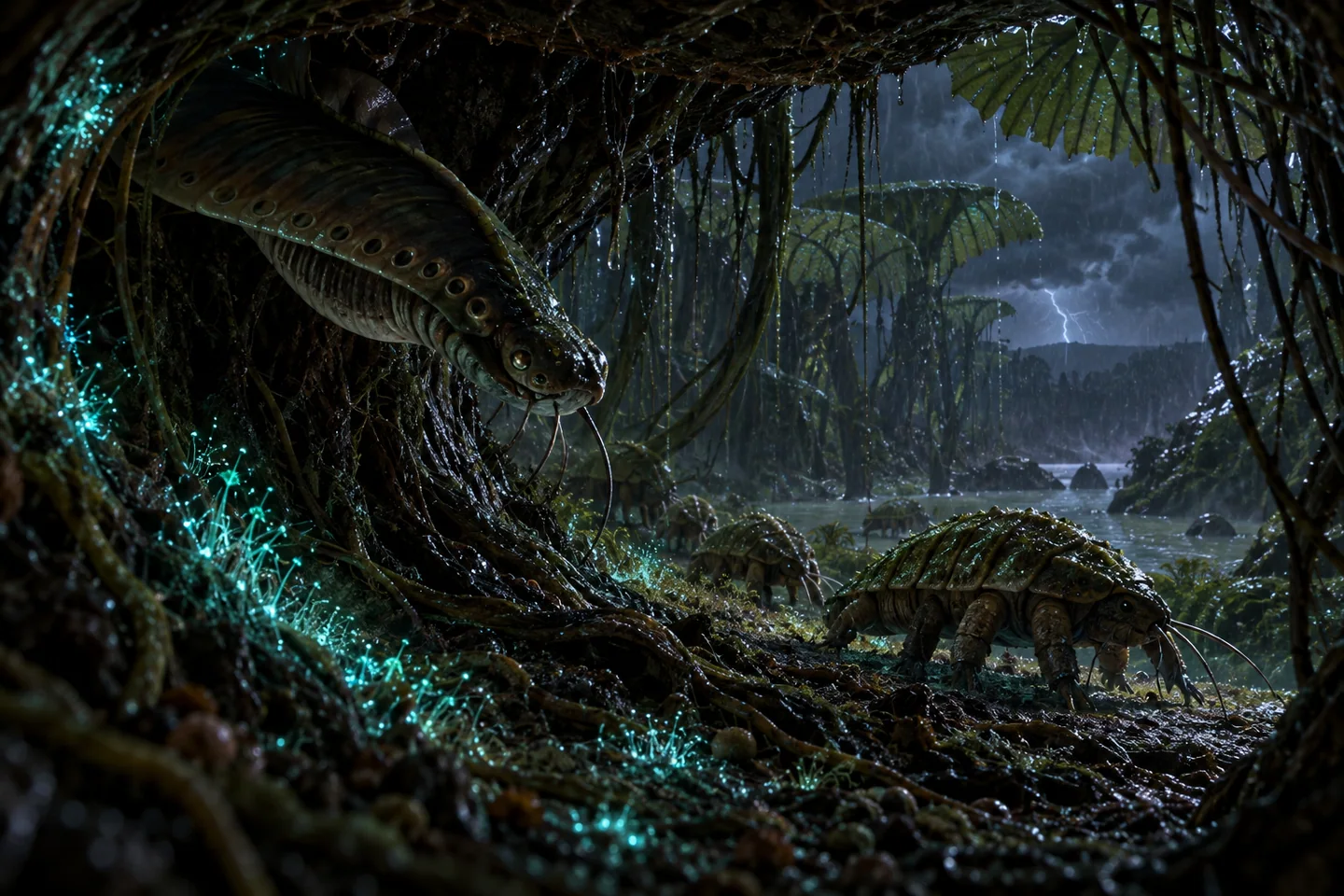 Kepler-442 bKepler-442 b — nightImagined alien life
Worlds at war01 imagined view

Ancient Alien Worlds · When Stone Held the Stars01 imagined view
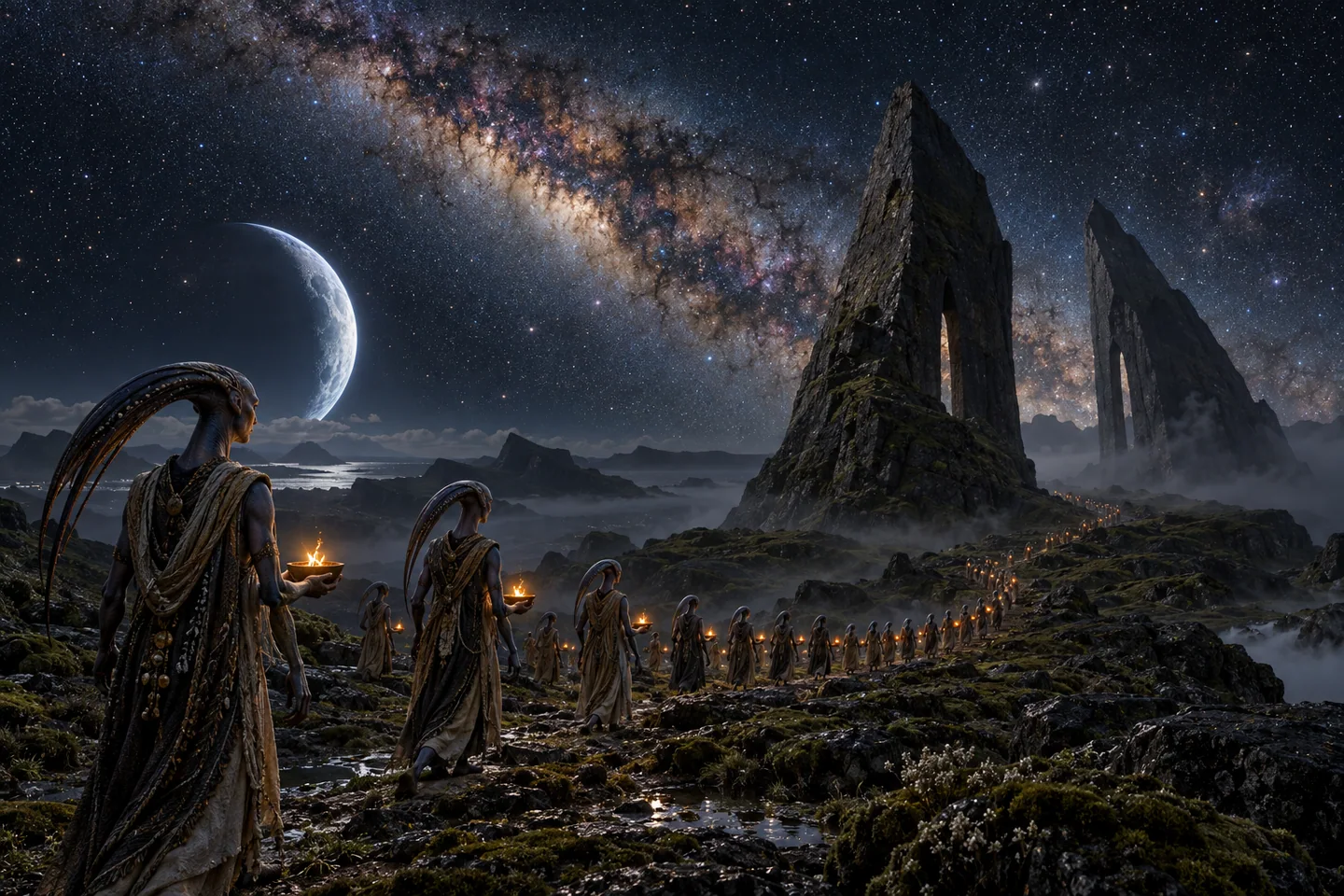
Alien Home Life · Where We Belong01 imagined view

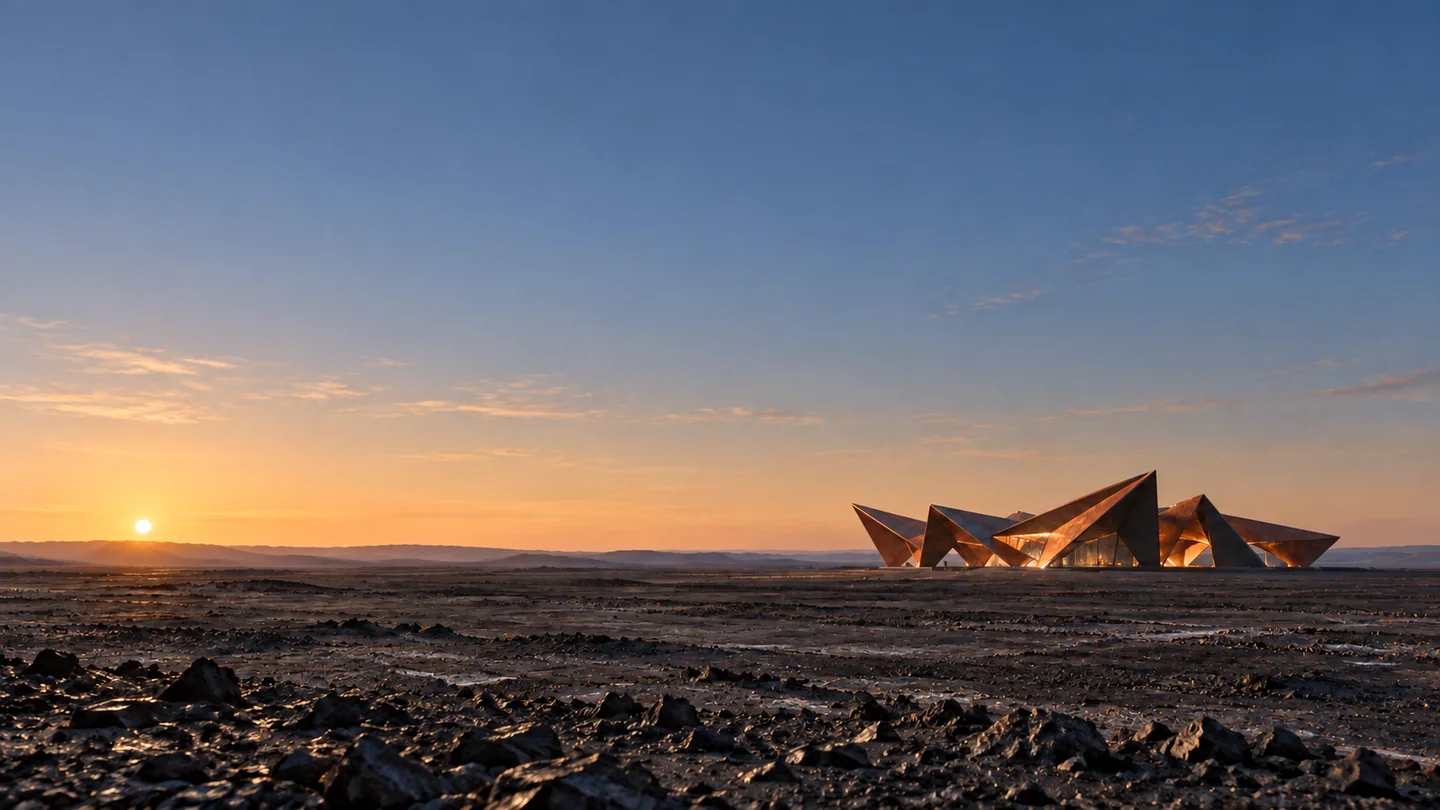
Architectures of the Cosmos · Megastructures01 imagined view
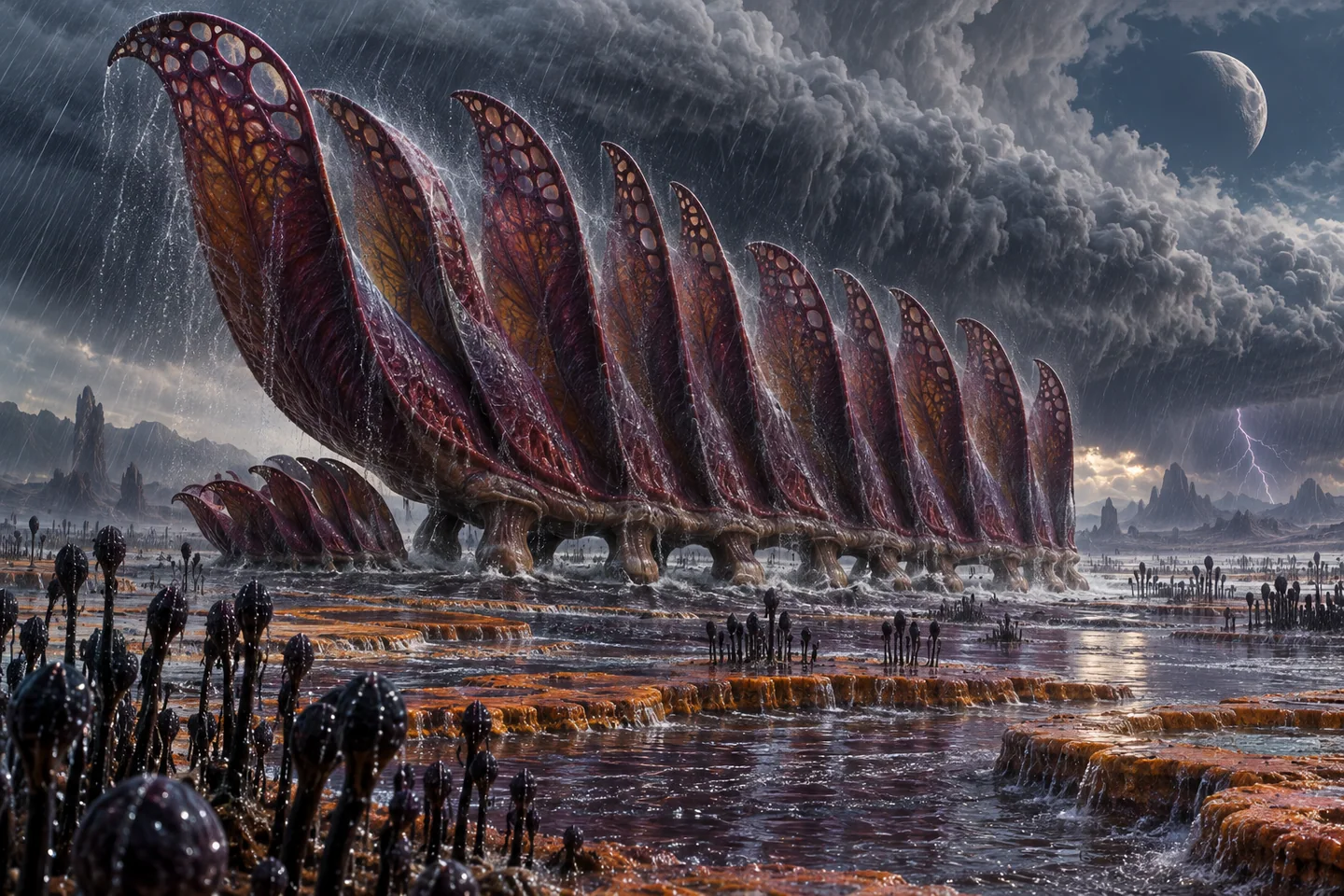
Before Names · Prehistoric alien worlds01 imagined view
The real world, in the literature
The host system is real. All alien organisms, robots, societies and social histories are fictional. Moons, rings, terrain and weather are artistic assumptions unless specifically supported by a cited source. These images are not calibrated simulations of the sky.
Torres et al. 2015 · Q1-Q17 DR25 KOI Table · TICv8
NASA composite catalog values may combine different papers. Errors and upper/lower limits are retained. “Calculated Value” means derived or estimated. Msini is a minimum mass. Missing values are unknown. A multiple-star system’s single stellar row does not describe every component. Equilibrium temperature is not a measured surface temperature.
| Quantity | Value & uncertainty | Unit | Paper / source |
|---|---|---|---|
| Planet radius | 1.34 [+0.11 / -0.18] | Earth radii | Torres et al. 2015 |
| Planet mass | 2.36 | Earth masses | Calculated Value |
| Bulk density | 5.39 | g/cm³ | Calculated Value |
| Orbital period | 112.31 [+0.0024 / -0.0028] | days | Torres et al. 2015 |
| Orbital semimajor axis | 0.409 [+0.209 / -0.06] | AU | Torres et al. 2015 |
| Orbital eccentricity | ≥ 0.04 (lower limit) [+0.08 / -0.04] | Torres et al. 2015 | |
| Orbital inclination | 89.94 [+0.06 / -0.12] | degrees | Torres et al. 2015 |
| Irradiation | 0.66 [+0.23 / -0.41] | Earth flux | Torres et al. 2015 |
| Equilibrium temperature | 241 | K; not surface temperature | Q1-Q17 DR25 KOI Table |
| Catalog stellar effective temperature | 4,402 [+100 / -100] | K | Torres et al. 2015 |
| Catalog stellar radius | 0.598 [+0.023 / -0.024] | Solar radii | Torres et al. 2015 |
| Catalog stellar mass | 0.609 [+0.03 / -0.026] | Solar masses | Torres et al. 2015 |
| Catalog stellar luminosity | -0.932 [+0.081 / -0.064] | log10 Solar luminosity | Torres et al. 2015 |
| Catalog stellar age | 2.9 [+8.1 / -0.2] | Gyr | Torres et al. 2015 |
| Catalog stellar metallicity | -0.37 [+0.1 / -0.1] | dex | Torres et al. 2015 |
| System distance | 365.96 [+2.763 / -2.724] | pc | TICv8 |